

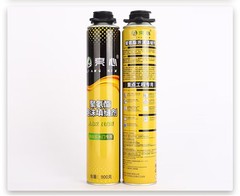
Polyurethane foam boasts numerous and significant advantages. Firstly, its exceptional expansion capacity. After being sprayed, the foam rapidly expands to 20-80 times its original volume, or even higher. This allows it to effectively fill irregular gaps and pores, avoiding the waste and unevenness problems associated with traditional fillers.
Secondly, it exhibits high bonding strength. The cured polyurethane foam forms a tough foam that adheres firmly to various substrates such as wood, metal, and concrete. Its shear strength reaches 0.5-1.0 MPa, far exceeding that of ordinary adhesives. This makes it outstanding in structural reinforcement.
Waterproofing and thermal insulation properties are another highlight. The closed-cell ratio of the foam typically exceeds 90%, effectively preventing moisture penetration and making it suitable for humid environments. Simultaneously, its low thermal conductivity (approximately 0.02-0.03 W/m·K), several times that of traditional insulation materials, makes it widely used in building energy conservation.
Furthermore, polyurethane foam also possesses good sound insulation properties. Foam structures absorb sound waves and reduce noise transmission, making them commonly used for sealing doors and windows in home decoration to improve living comfort. They are highly resistant to chemical corrosion, resisting acids, alkalis, and organic solvents, making them suitable for industrial applications.
From a physical perspective, this material is lightweight, with a cured density of only 20-50 kg/m³, which does not increase structural load. It also possesses a degree of elasticity, able to withstand deformation caused by thermal expansion and contraction, reducing the risk of cracking.
In terms of environmental protection, modern polyurethane foam adhesives mostly use low-volatile organic compound (VOC) formulations, reducing air pollution. Relevant regulations, such as GB 18583-2008 "Limits of Hazardous Substances in Adhesives for Interior Decoration and Renovation Materials," impose strict requirements on these products to ensure safe use.
However, limitations must also be noted, such as sensitivity to ultraviolet light and aging with long-term exposure, making them unsuitable for outdoor uncovered areas. Overall, however, these characteristics make polyurethane foam adhesives a preferred material in many fields.